skip to main |
skip to sidebar
The conservation charity Fauna & Flora International (FFI) have recently launched an appeal for funding to help safeguard the future of African Wild dogs in Mozambique, currently faced with extinction.
The Niassa National Reserve in the north of the country boasts a rich diversity of wildlife, including large populations of elephant and sable antelope, as well as various big predators, such as lion, leopard and hyena. One of the parks other predators is the rare African Wild dog, of which approximately 450 individuals reside. FFI has been working with their local partner to manage the reserve for almost 10 years, and have achieved remarkable success in this relatively short period of time. Despite this however, they still face many challenges, and continued support is paramount for further success in the future.
As part of the appeal, I have donated a limited edition print of one of these dogs, which can be bid for on ebay. 100% of proceeds go to FFI.

 I recently did an interview with Southwark News. You can read the full story online here.
Over the past 10 years House sparrow numbers have declined dramatically in the city of London. I recently provided the illustrations for an awareness campaign by Westminster City Council.
Please send your sightings of this bird to Greenspace Information for Greater London (GiGL):
http://www.gigl.org.uk/

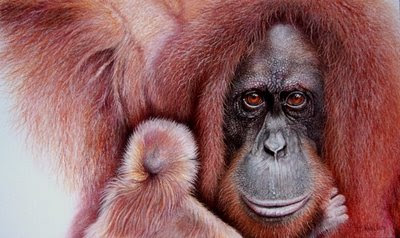
I was thrilled to learn that my pastel of a Sumatran orangutan and baby was voted third in the visitors choice award at the Society of Wildlife Artists exhibition, out of 400 other works.
I would like to encourage artists from around the world to enter the 2009 Wildlife Artist of the Year competition, put on by the David Shepherd Wildlife Foundation in aid of wildlife.
Click on the following link to submit your work:
http://www.wildlifeartistoftheyear.org/
Closing date for entries is the 31st January 2009.
.jpg)
45th annual exhibition 2008 (September 24th - October 5th)
Open every day from 10am - 5pm. Admission £2.50 (Consessions £1.50)
http://www.swla.co.uk
My passion for wildlife art developed in Africa, stimulated by the continent's sharp tropical light and dramatic colour palette. With zoologists as parents, my early years were spent with a sketchbook to keep me quiet in the back of the Land Rover, as a real “Life on Earth” show paraded outside the window. Hours without a television were occupied instead with my personal zoo of bugs and beasties – snakes, chameleons, antlions and many others. Crusty and scaly creatures later became the focus of my first solo exhibition “Metamorphosis”. Living in the shadow of the Virunga volcanoes, mountain gorillas were in the backdrop to my childhood. I saw them only once, accidentally on a forest walk, but I was hooked.
Back home in the chilly English winter I learnt to focus amidst distraction as the only boy in an art class of seven girls, and had my creative abilities stretched by Sculptor Oliver Barratt. Gradually I noticed that primates were starting to predominate in my mind and artwork, especially the great apes. I had grown up with tales from the forests of Sumatra, of the red ape – the “man of the forest”, of gibbons swinging and calling through the canopy, and of the people who lived in and around their habitat. I became obsessed with travelling to Asia, seeing orangutans in the wild, learning about their conservation, re-tracing my parents footsteps in Sumatra and seeing what had transpired for orangutans in the intervening years.
The Society of Wildlife Artists bursary turned this dream into reality, and I am extremely grateful to the SWLA and CAPMARK Europe for their crucial support. In January this year I spent two weeks in Bukit Lawang, on the edge of the Gunung Leuser Reserve. I stayed with Samsul, whose father and grandfather had led my parents on many forest treks, and who has set up a small ecotourism business alongside the fast-flowing Bohorok river. It is an artists paradise and, although you have to work for your wildlife moments in this hilly and humid habitat, the light, the forest, the sounds are inspiring and my sketchbook filled up rapidly. The ultimate aim of this trip was to harness that inspiration and gather research for an illustrated book – a collaboration that reflects on the past, present and future of orangutans and the people who are part of their conservation story. Making this into a published reality is now my focus. My two pieces in this year's exhibition, of an orangutan and a Thomas’s leaf monkey, are contemplative of the future too – who will survive and how?
Thomas's Leaf MonkeyPastel Pencils


